
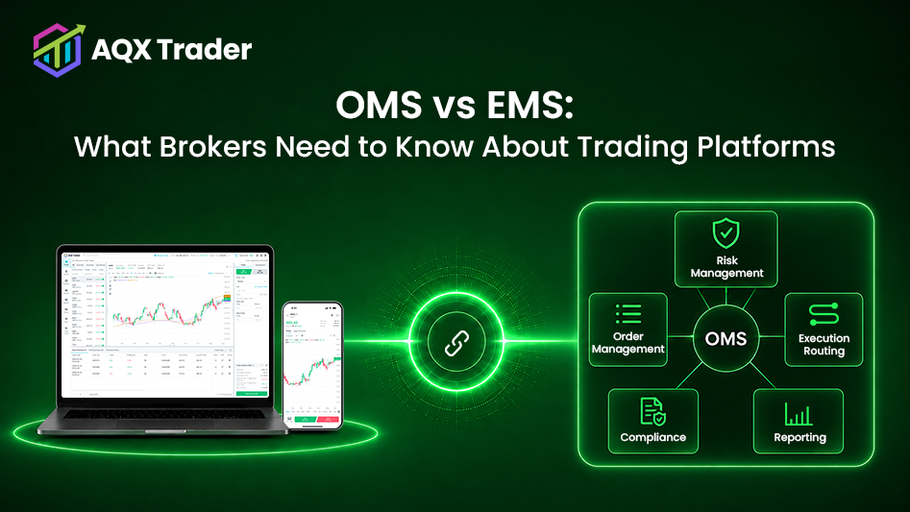
Ask a broker to explain the difference between their OMS and their EMS, and the answer usually collapses into one word: "backend." Ask how that backend differs from the trading platform traders open every morning, and the answer gets vaguer still. That's not a knowledge gap. It's because "platform" gets used to mean three different systems depending on who's talking, and most vendors have no incentive to clear that up.
Three layers are doing three different jobs. The trading platform is what traders see. The OMS manages what happens to an order after they click. The EMS decides how that order actually gets executed. Confusing any two of them, or treating them as interchangeable, is how brokers end up with a platform that looks polished in a demo and falls apart under real order flow.
Get that architecture wrong, and no amount of front-end polish fixes what traders actually experience once volume picks up.
What a Front-End Trading Platform Actually Does
Start with the layer everyone already understands, since it's the one that makes OMS and EMS easy to misdiagnose later.
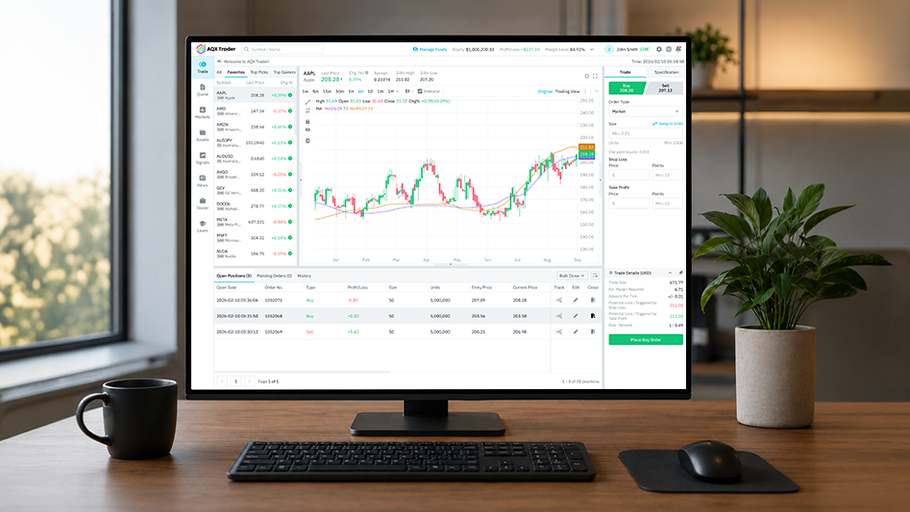
The trading platform is the interface layer: charts, watchlists, order tickets, account views, the mobile app, the web terminal. It's where a trader decides to open a position, sets their stop, and hits buy or sell.
A good front end handles a few things well:
- Renders live pricing and market data without lag
- Gives traders tools like one-click trading and in-chart order placement, and DOM-style execution views
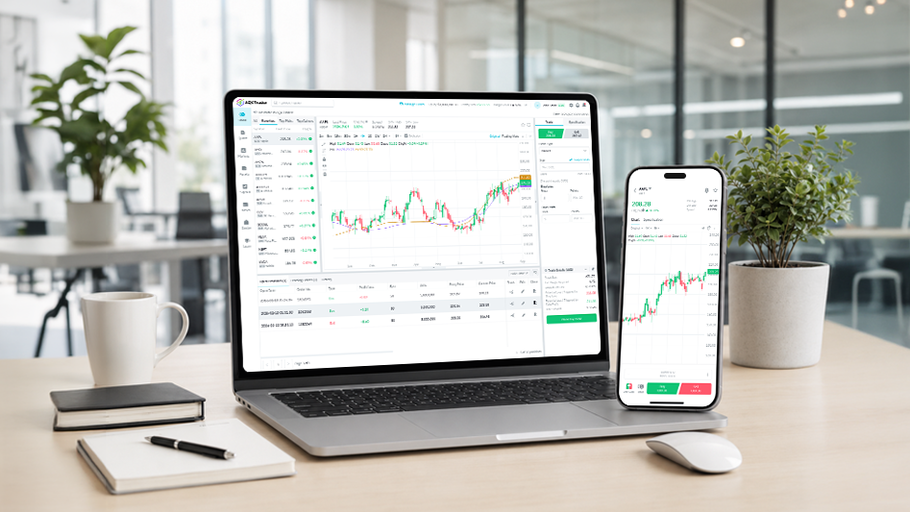
- Works consistently across desktop, web, and mobile, so a trader's watchlist and open positions look the same wherever they log in
- Lets brokers control branding, symbol lists, layout, and feature availability without submitting a ticket to a dev team
The first two are what traders notice immediately. The last two are just as important, but brokers usually don't feel their absence until they need to make a change and discover how many steps it actually takes.
What the front end does not do, on its own, is decide how an order gets filled. That job splits into two systems working together: one manages the order, the other decides how it's executed. That split, OMS vs EMS, is where most of the real confusion lives, and none of it is visible to the trader.
OMS vs EMS: What Each Layer Actually Handles
An order management system (OMS) takes the order the trader placed and manages its lifecycle: validation, risk checks, routing decisions, and record-keeping. It's the layer that decides whether an order goes to a liquidity provider, gets matched internally, or triggers a dealing desk review.
An execution management system (EMS) picks up from there. Once the OMS has cleared and routed the order, the EMS handles getting it filled: selecting the venue or liquidity provider, managing partial fills or rejections, and optimizing for price and speed. Where the OMS asks whether an order is allowed to happen, the EMS asks what the best way to make it happen actually is.A market order on EUR/USD moves through both layers before the trader sees anything. The OMS checks it against margin and risk limits and decides whether it's matched internally or routed out. If it's routed out, the EMS takes over, choosing which liquidity provider gets the order and how it's worked to get filled at the best available price. The trader just sees a fill confirmation, a few milliseconds later.
In practice, most retail brokerage platforms don't run OMS and EMS as two fully separate systems the way large institutional desks might. Many white-label setups bundle the two together, sometimes described as OEMS, with the routing logic embedded directly into the execution layer. Whether that's the right setup comes down to complexity, not size.
A single-liquidity-provider setup with straightforward routing rarely benefits from running OMS and EMS as separate vendor relationships, the integration overhead usually outweighs the benefit. Separation starts to earn its cost once a broker runs multiple liquidity providers with different routing logic, needs algorithmic execution, or has a regulatory requirement to keep order validation and execution decisions auditable as distinct steps. Below that threshold, a well-built OEMS setup covers both jobs without the added vendor complexity.
The OMS side is also where the audit trail lives. Every order needs a record of when it was placed, how it was validated, where it was routed, and how it was filled. For a regulated broker, that's not optional infrastructure, it's the evidence a regulator asks for during any dispute. When a broker can't produce that trail quickly, the gap traces back to this layer, not to whichever front end the trader happened to be using. Getting OMS integration right is as much a compliance question as it is a performance one.
None of this is visible to the trader. They just experience it as "the platform is fast" or "the platform is slow."
Why "Which One Matters More" Is the Wrong Question
Brokers evaluating platforms often end up picking a side. Some prioritize the front end because that's what traders will judge them on immediately. Others prioritize the execution stack because a bad fill or a compliance gap creates real financial and regulatory exposure.
Both instincts are reasonable. Both miss the actual point.
Part of why this debate persists is organizational, not technical. Front-end vendor selection is often owned by product or marketing, while OMS and liquidity provider relationships sit with an ops or dealing desk team. Each side evaluates the platform against different priorities, and neither is wrong on its own terms. But if nobody owns the question of how the two actually connect, that gap becomes the broker's problem, not the vendor's, usually discovered after launch.
A trading platform with a beautiful interface sitting on top of a poorly integrated OMS will eventually produce delayed fills, mismatched position data, or order rejections that show up as "the platform is buggy" in trader complaints. Conversely, a technically excellent OMS connected to a clunky, slow front end will lose traders before they ever find out how well the backend performs. Front-end friction shows up fastest.
Backend friction shows up when it's already expensive to fix.
The real evaluation question is narrower: does the front end talk to the execution layer cleanly enough that traders never notice the seam between them?
Where Integration Actually Breaks
A few patterns show up repeatedly when brokers troubleshoot platform complaints that turn out to be architecture problems:
Order status lag. A trade executes on the backend, but the front end takes a few seconds to reflect the fill. Traders assume the platform froze.
Symbol and pricing mismatches. The OMS routes based on one instrument list, the front end displays another, and reconciliation becomes a manual process instead of an automatic one.
Execution routing drift. The EMS routes to a liquidity provider based on stale spread or depth data, and the order fills at a worse price than the broker's actual best available rate, while the front end reports the trade as normal.
Multi-device inconsistency. A position closed on mobile doesn't immediately reflect on desktop, because the two clients are pulling from different cache layers instead of a shared source of truth.
Broker-side changes that don't propagate. A broker adds a new symbol or adjusts spreads at the OMS level, and the front end doesn't pick up the change without a manual sync or a support ticket.
Reconciliation gaps. Compliance and finance teams pull records from the front end and the OMS separately, and when the two don't line up exactly, month-end reconciliation turns into a manual spreadsheet exercise instead of an automated report.
Individually, these look like small bugs. Collectively, they're usually a sign that the front end and the execution stack were never designed to work together in the first place, they were connected after the fact.
The cost compounds fast. A trader who hits order status lag or a symbol mismatch in their first week rarely files a support ticket explaining the root cause. They just decide the platform is unreliable and leave. That's the expensive version of an architecture problem: it doesn't show up as a bug report, it shows up as churn.
What Brokers Should Actually Ask When Evaluating a Platform
Instead of asking "is this a good trading platform" or "is this a strong OMS," a more useful line of questioning looks like this:
Does the front end connect natively to multiple OMS setups, or does it require custom integration work for each one? Custom work per setup is where implementation timelines and long-term maintenance costs quietly multiply.
What protocols does it support for connecting to liquidity providers and bridges, FIX, REST, WebSocket, and is that documented or something you have to ask engineering about? Undocumented connectivity is usually a sign the integration was never built to be repeatable.
When a broker changes a symbol, spread, or margin setting, how quickly does that reflect across every client, desktop, web, and mobile? A delay here is the same architecture gap from the earlier section, just visible from the broker's side of the screen instead of the trader's.
If order volume spikes, does the front end still reflect real-time status, or does it start lagging behind the execution layer? Volume spikes are exactly when traders are watching the platform most closely.
Is the execution logic something the broker can see and adjust, or is it a black box the vendor controls entirely? Visibility matters for operational control today and for answering a regulator's questions later.
Can the platform tell you whether a bad outcome traces back to the OMS side, a routing or compliance decision, or the EMS side, an execution or liquidity issue? Without that visibility, you know something went wrong but not what to fix or who to escalate to.
These questions tend to surface the difference between a platform that was architected as one system and a platform that's a front end bolted onto whatever OMS happened to be available. Vendors with a genuinely integrated stack tend to answer plainly, often with documentation ready to hand over. Vague, reassurance-only answers are worth treating as a flag rather than a formality.
Where AQX Trader Fits
AQX Trader is built as a front-end trading platform with multi-OMS connectivity and embedded EMS functionality, alongside dual protocol support (FIX and REST), rather than a front end tied to a single proprietary execution engine. That distinction matters for brokers who already run infrastructure they don't want to rip out, or who need the flexibility to change execution partners without rebuilding the trader-facing product.
Because execution routing sits inside the same architecture as order management rather than as a bolted-on third system, brokers aren't defaulting to stitching order management and execution together from two disconnected vendors. The multi-OMS connectivity still supports that when a broker's existing setup calls for it, the point is that it's a choice, not a workaround.
This also changes the switching-cost conversation. A broker replacing their front end doesn't need to unwind existing liquidity provider relationships or rebuild a bridge setup that already works. The front end changes; the OMS and EMS infrastructure the broker has already invested in stays in place.
Symbol updates, spread adjustments, and feature toggles made on the broker side are built to reflect consistently across desktop, web, mobile app, and mobile web, because that connectivity sits at the architecture level rather than being patched in after launch. That's the specific gap most "front end vs OMS vs EMS" comparisons are actually about: not which layer matters more, but whether the layers were designed to move together.
For brokers evaluating platforms, the practical takeaway isn't to pick a side between the front end, the OMS, and the EMS. It's to ask whether the vendor in front of you can explain, specifically, how those layers talk to each other, and how fast. That answer says more about how the platform holds up at scale, and how easily it supports your next market or asset class, than any feature list on a sales deck.
See how AQX Trader connects front-end execution to your existing OMS and EMS infrastructure. Book a demo here.
Latest News
