

A client calls the desk with a sizable physical gold position to hedge.
The first question sounds straightforward: what price can you give me?
The answer can be less straightforward.
The price displayed on a trading screen may represent only the first level of available liquidity. A larger order can interact with several price levels. The dealer still has to decide how to work that order. If the client wants gold quoted in a local currency, there is an FX component to consider as well. And once the hedge is placed, the book may still be left with residual exposure.
For brokers, the infrastructure behind precious-metals trading therefore goes beyond making XAUUSD available.
The more useful question is: What can your desk actually see and manage before, during and after a precious-metals order is executed?
Gold is already a meaningful part of trading activity
There is little need to manufacture a case for client interest in gold.
Capital.com reported that gold accounted for 42.4% of its total platform trading volume in Q2 2026, the highest share of any instrument on its platform. Total client trading volume for the quarter reached US$1.13 trillion, while average trade size increased 16% quarter on quarter to US$32,418. These figures represent Capital.com's own platform rather than the wider retail market, but they provide a useful example of how significant gold activity can become within a trading business. [1] (Capital.com)
Activity was also elevated in exchange-traded metals markets. CME Group reported record Metals average daily volume of approximately 1.7 million contracts in Q1 2026, up 127% year on year. Micro Gold futures ADV reached 714,000 contracts, Micro Silver reached 263,000, and Gold futures ADV increased 20% to 282,000. These are exchange-traded derivatives figures, not CFD or retail-broker volumes, so they measure a different part of the market. [2] (CME Group)
The underlying gold market remains substantial in its own right. According to the World Gold Council, total gold demand in H1 2026 reached 2,522 tonnes, up 2% year on year, with a record value of US$380 billion. [3] (World Gold Council)
These datasets should not be combined into a single measure of "gold trading demand". They represent different markets and different types of activity.
What they do establish is why the execution question deserves attention.
When precious metals become a meaningful part of client flow, the quality of the offering depends on more than whether a symbol is available.
A large gold order can move beyond the price you see
Consider a dealer looking at a gold quote.
The best offer is immediately visible. But how much liquidity is actually available at that price?
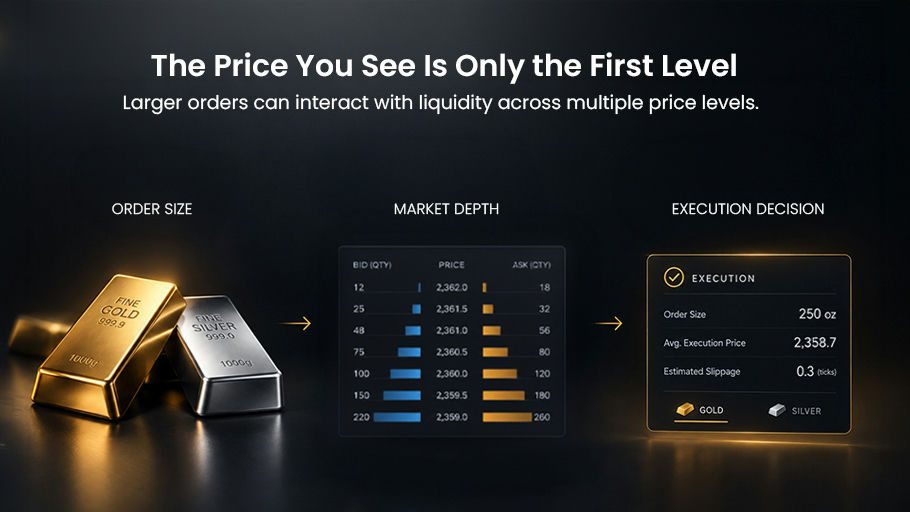
For a relatively small order, the first level of liquidity may be sufficient. Increase the size and the situation can change. If there is not enough quantity at the first level, the remaining order may need to interact with subsequent prices.
That distinction matters because top of book tells you the first available price. It does not tell you the full pricing picture if an order needs liquidity deeper in the book.
CME Group's Liquidity Tool separates three relevant measures: cost to trade, bid-ask spread and book depth. Its cost-to-trade analysis can also be adjusted for different lot sizes, while the book-depth view allows users to examine liquidity across multiple price levels. [4] CME's Market by Order documentation similarly describes the full depth of the book as visibility into orders and quantities across price levels rather than only the top level. [5] (CME Group)
Take a simplified example.
A dealer needs to execute an order for 1,500 units. There are 500 available at the first price level, another 500 at the second, and the final 500 at a third. The full order therefore cannot be understood simply by multiplying 1,500 by the first displayed price. Completing it requires liquidity from several levels, producing an average execution price across those levels.
Real markets are more dynamic than this example. Orders can be added or withdrawn, quantities can change, and visible depth does not guarantee the eventual fill. That distinction is important.
Depth is information, not a promise of execution.
Its value is that it gives the dealer more information about what currently sits behind the first price before the execution decision is made.
For a client hedging a commercially meaningful physical position, discovering the difference only after execution is not a particularly useful workflow. The desk should be able to see what it is working with beforehand.
Market or limit? The desk still has to make a decision
Seeing the depth does not remove the execution decision. It makes that decision better informed.
Suppose the client wants the hedge completed immediately. A market order prioritises execution against available prices. If the required quantity extends across several price levels, however, the resulting average fill can differ from the first price shown.
A limit order changes the trade-off. The dealer specifies the acceptable price boundary, gaining greater price control, but the order may remain partially or completely unfilled if sufficient liquidity is unavailable at that price.
CME Group describes the same underlying distinction in its educational material on order types. Market orders interact with available prices, while limit orders allow a buyer to define a maximum purchase price or a seller to define a minimum sale price. In a moving market, a limit order may not fill. [6] (CME Group)
For a precious-metals desk, the important question is not whether one order type is inherently better.
It is: What information does the dealer have when choosing between them?
Without visibility into the liquidity behind the first level, that choice is made with less information about the book. With depth visible, the dealer has more context for deciding how to work the order.
That still does not guarantee the eventual result. It improves what the dealer knows before committing to an execution approach.
A local-currency gold quote has another moving part
Execution price is only one part of the picture.
A client may not want to think in XAUUSD at all.
A Singapore jewellery business may price inventory, revenues and margins in Singapore dollars. A European client may want the economics of its hedge expressed in euros. For a commercial user, the local currency may be far more relevant to the business than the convention in which the underlying gold market is quoted.
Once gold is expressed in another currency, the quote reflects two moving components.
**Gold ** and FX.
The World Gold Council illustrates the principle in its own gold-price methodology. Its underlying gold price is quoted in US dollars, while prices presented in other currencies are converted using the applicable foreign-exchange rate at, or as close as possible to, the same point in time. [7] (World Gold Council)
For a dealing desk, that means the economics of the local-currency quote are influenced by both the precious-metals price and the FX rate.
Addressing the gold exposure does not necessarily mean the currency component has disappeared.
This is where the transaction can appear simpler to the client than it is to the dealer. The client sees one local-currency gold price. The desk needs to understand what sits underneath that price.
The leg nobody hedged
The point is not that every local-currency gold trade automatically leaves the broker with an unhedged currency position.
It is that the FX component exists and needs to remain visible within the hedging process.
Synthetic crosses provide a way to bring those components together. Instead of treating local-currency precious metals as an opaque single quote, the desk can price the synthetic instrument while retaining visibility into the underlying metals and currency components.
That visibility matters when determining what has been hedged and what exposure remains.

Small residual positions can become meaningful exposure
Even once the primary hedge has been placed, the book may not be perfectly flat.
Client transactions and hedges do not always align exactly. Differences in quantity, timing or the instruments used can leave smaller residual positions.
One residual may be too small to attract much attention. The operational issue is what happens across many transactions.
If client flows naturally offset each other, some of those positions may cancel out. If client activity repeatedly faces the same direction, however, residuals can accumulate instead.
What looks insignificant trade by trade can become meaningful when viewed across the whole book.
The exposure nobody decided to take
The broader principle is familiar across financial markets.
Research from the Bank for International Settlements on FX settlement found that pre-settlement netting reduced approximately US$2.2 trillion in average daily gross obligations to US$337 billion remaining to be settled by other means. The authors also noted that netting compression tends to be lower for customer obligations than inter-dealer obligations because customer FX positions tend to be more directional. [8] (Bank for International Settlements)
That research concerns the global FX market and settlement risk. There is no evidence about bullion-dealer residual books specifically.
The relevant principle is narrower: offsetting changes the exposure that remains, and the remainder still matters. For a precious-metals desk, the practical requirement is visibility.
The dealer should be able to understand what has been hedged, what remains, and whether a collection of individually small positions has become significant enough to require action.
Residual exposure management brings those remaining positions into the hedging workflow instead of leaving them scattered across the book until someone eventually notices them.
Four questions the desk should be able to answer
Across these scenarios, the technology question becomes much more practical.
Before, during and after a client's precious-metals order, can the desk answer four things?
- What liquidity sits behind the first displayed price?
- Given that liquidity, how should the order be worked?
- If the client is quoted in local currency, what exposure sits in the FX component?
- Once the principal hedge is placed, what exposure remains?
These questions relate to different stages of the same workflow.
Market depth concerns what is available before execution.
Order type concerns how the desk decides to interact with that liquidity.
Synthetic crosses concern the components inside a local-currency precious-metals quote.
Residual exposure concerns what remains after the main hedge has been addressed.
A useful trading workflow should make those questions easier to answer rather than forcing dealers to reconstruct the picture across separate screens and manual processes.
How QuoteBoard brings more of the execution picture into view
QuoteBoard is designed to bring these desk-level questions into a single precious-metals workflow within AQX Trader.
For larger orders, QuoteBoard displays seven levels of market depth with quantities at each level. Where an order exceeds the liquidity available at the top of the book, a volume-aggregated price is calculated before the order goes through.
That changes the starting point for the dealer.
Instead of seeing only the first BUY or SELL price, the desk can inspect the liquidity available behind it and understand how the size of the order interacts with the visible book.
QuoteBoard also supports Market, Limit and Stop orders, together with GTC, FOK and IOC time-in-force options. This brings pricing, depth and the execution decision into the same workflow rather than treating them as separate problems.
For local-currency precious-metals activity, synthetic crosses extend the view to the metals and FX components of the quote. This helps the desk retain visibility into the currency exposure associated with local-currency pricing.
The same principle continues after the main hedge. Residual positions can be identified and brought into the hedging workflow as they become meaningful, rather than remaining unnoticed as a series of individually small exposures.
The campaign therefore addresses four distinct moments in the same dealer workflow:
- Market depth: What liquidity is actually available?
- Execution: How should the order be worked?
- Synthetic crosses: What sits behind the local-currency quote?
- Residual exposure: What remains after hedging?
QuoteBoard does not remove market risk, guarantee a fill or make the execution decision for the dealer. Its role is to give the desk more visibility into the order and the exposures surrounding it.
That distinction matters.
The client sees a price. The desk needs to see what sits behind it.
For the client, the request may be simple.
Hedge the gold. Quote it in the currency the business uses. Execute it at an acceptable price.
For the dealer, each instruction sits on top of a deeper set of questions about liquidity, execution and exposure.
A sizable precious-metals order may extend beyond the first price displayed. Choosing between market and limit involves a trade-off between execution and price control. Local-currency gold introduces an FX component. Hedging can leave residual positions that need to be monitored as the book evolves.
The role of the trading platform is not to pretend those questions disappear.
It is to give the desk better visibility into them.
**See how QuoteBoard on AQX Trader supports metals at scale. **
FAQ
What liquidity sits behind the first displayed gold price? The price shown on a trading screen typically represents only the first level of available liquidity. Larger orders can interact with multiple price levels, and full market depth tools show quantities available at each level before an order is executed.
How should a dealer decide between a market order and a limit order for gold? A market order prioritizes execution against available prices but may fill across multiple levels at an average price. A limit order gives the dealer price control by setting a boundary, but the order may go partially or fully unfilled if liquidity isn't available at that price.
What FX exposure exists when gold is quoted in a local currency? A gold price quoted in a currency other than USD reflects two moving components: the underlying gold price and the applicable FX rate. Synthetic crosses let a desk price the local-currency quote while retaining visibility into both the metals and currency components separately.
What happens to residual exposure after a gold hedge is placed? Client transactions and hedges rarely align exactly, leaving small residual positions. If client flow consistently faces one direction, these residuals can accumulate into meaningful exposure over time, so they need to remain visible and be actively monitored rather than left unaddressed.
References
[1] Capital.com. (2026, July 9). Capital.com: Gold accounts for 42% of Q2 trading volume as commodity markets shaped trader decisions. https://capital.com/en-eu/press/capital-com-gold-accounts-for-42-of-q2-trading-volume-as-commodity-markets-shaped-trader-decisions (Capital.com)
[2] CME Group. (2026, April 2). CME Group reaches all-time record monthly and quarterly average daily volume. https://www.cmegroup.com/media-room/press-releases/2026/4/02/cme_group_reachesall-timerecordmonthlyandquarterlyaveragedailyvo.html (CME Group)
[3] Street, L., & Gopaul, K. (2026, July 30). Gold demand trends: Q2 2026. World Gold Council. https://www.gold.org/goldhub/research/gold-demand-trends/gold-demand-trends-q2-2026 (World Gold Council)
[4] CME Group. (n.d.). CME Liquidity Tool user guide. https://www.cmegroup.com/education/demos-and-tutorials/cme-liquidity-tool-user-guide (CME Group)
[5] CME Group. (n.d.). Market by Order (MBO). https://www.cmegroup.com/articles/faqs/market-by-order-mbo.html (CME Group)
[6] CME Group. (n.d.). Futures order types. https://www.cmegroup.com/education/courses/futures-trading-mechanics-and-regulation/futures-order-types (CME Group)
[7] World Gold Council. (n.d.). Methodology note. https://www.gold.org/data/gold-price/methodology (World Gold Council)
[8] Conway, M., Drehmann, M., Lovell, N., McGuire, P., & Shirakami, T. (2026, June). Uncovering FX settlement risk: New measures from the 2025 BIS Triennial Survey. BIS Quarterly Review, 17–29. https://www.bis.org/publ/qtrpdf/r_qt2606.pdf (Bank for International Settlements)
Latest News
