

April 2026 marked a decisive shift across financial services — one where innovation continues to accelerate, but the tolerance for unstructured growth is rapidly disappearing.
From AI-native financial capabilities to tightening global crypto regulation and explicit compliance enforcement timelines, the message this month is clear: the industry is moving from experimentation to accountability.
This edition of FinFocus unpacks the signals shaping that transition — and what they mean for fintech operators, brokers, and platforms navigating the months ahead.
AI in Finance Is Moving Deeper Into the Stack
 13 April 2026, Source: TechCrunch / American Banker
OpenAI’s acquisition of Hiro Finance is not just another headline — it reflects a broader strategic direction. AI companies are no longer building adjacent tools for finance; they are embedding financial reasoning directly into their core models.
This shift matters. Historically, financial guidance has been mediated by platforms, advisors, and access barriers. AI is now positioned to make that guidance scalable, programmable, and widely accessible.
At the same time, regulators are beginning to treat AI as a core component of financial infrastructure. The Bank of England has confirmed plans to stress test AI agents operating in trading environments, with particular focus on systemic risks such as correlated behaviour across autonomous systems.
Together, these developments signal a new reality: AI in financial services is no longer just a competitive advantage — it is becoming a regulated surface area.
For firms, the implications are immediate. It is no longer sufficient to deploy AI capabilities. Organisations must also be able to demonstrate:
- How these systems behave under stress
- What controls govern their outputs
- How decisions can be audited and explained
In this environment, trust and transparency will differentiate more than raw capability.
Crypto Regulation Is Converging Across Markets
April also highlighted a clear trend in digital asset regulation: convergence toward traditional financial standards.
 10 April 2026, Source: CoinDesk
Japan’s decision to classify cryptocurrencies as financial instruments represents a structural shift. By bringing digital assets under securities-style regulation, the country is introducing stricter rules around disclosures, market conduct, and enforcement.
This move aligns with broader regional momentum across Asia, where regulators are increasingly standardising frameworks to support institutional participation while strengthening investor protection.
 16 April 2026, Source: UK Parliament - Treasury Committee
In parallel, developments in the United States continue to bridge crypto and traditional finance. Coinbase’s conditional approval for a national trust bank charter reflects a move toward federally regulated digital asset infrastructure, reducing reliance on fragmented state-level licensing.
For fintech firms, this convergence has practical consequences. Products and services that were previously treated as extensions of payment systems are now being assessed against capital markets expectations.
This means:
- Greater scrutiny on custody and settlement infrastructure
- Stronger compliance requirements across jurisdictions
- Rising expectations from institutional clients
Regulatory clarity is increasing, but so is the cost of operating within it.
Compliance Expectations Are Becoming Enforceable
 8 April 2026, Source: U.S. Treasury / Covington and Burling
Perhaps the most significant shift this month is not regulatory intent, but regulatory enforcement.
In the United States, authorities have proposed a formal AML and sanctions framework for stablecoin issuers — including explicit requirements to monitor, block, and report transactions across both primary and secondary markets.
 17 April 2026, Source: ESMA
In Europe, the European Securities and Markets Authority has issued a definitive deadline: firms operating without proper authorisation under MiCA must comply or exit the market by 1 July 2026. These developments represent a clear turning point. Compliance is no longer something firms prepare for, it is something they must already be operationally ready to meet.
For many organisations, this introduces a critical challenge: aligning internal systems, controls, and processes with regulatory expectations under increasingly compressed timelines.
From Awareness to Readiness
Across AI, crypto, and regulatory enforcement, a consistent theme emerges:
The gap between recognising a requirement and being ready to meet it is shrinking.
- AI capabilities are advancing faster than governance frameworks
- Digital assets are being integrated into formal financial regulation
- Regulators are setting deadlines that require immediate action
In this environment, success will not be defined by how quickly firms innovate, but by how effectively they operationalise change. The firms best positioned for the next phase of fintech will be those that:
- Build infrastructure that adapts across jurisdictions
- Embed compliance into product and operational design from the outset
- Maintain systems that are auditable, resilient, and scalable
This is no longer about reacting to regulation. It is about designing organisations that can move with it.
Meet Us at Finance Magnates Summit Singapore
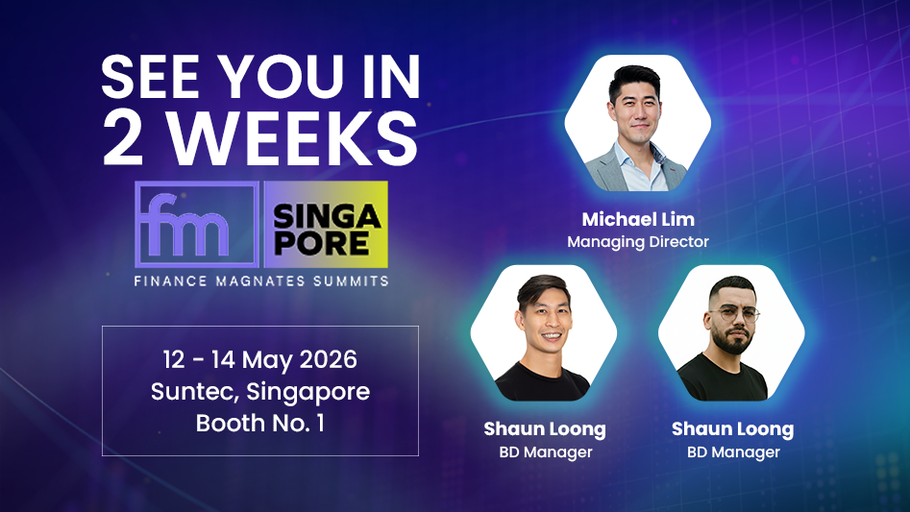 We will be attending the Finance Magnates Summit Singapore 2026 from 12–14 May at Suntec Singapore.
If you are attending, visit us at Booth No. 1. Whether you are exploring platform strategy, scaling brokerage operations, or preparing your infrastructure for evolving regulatory demands, we would be glad to connect.
Closing Perspective
April’s developments reinforce a broader industry shift: Innovation is still accelerating — but it is now happening within a framework of accountability, supervision, and enforcement.
The firms that will lead in this environment are not necessarily those moving the fastest, but those moving with structure, clarity, and readiness.
Because in 2026, the question is no longer whether regulation is coming. It is whether your organisation is already built to handle it.
FinFocus by Aquariux — Monthly Fintech Intelligence Briefing This article is based on publicly available information and is not financial or legal advice.
Latest News
