
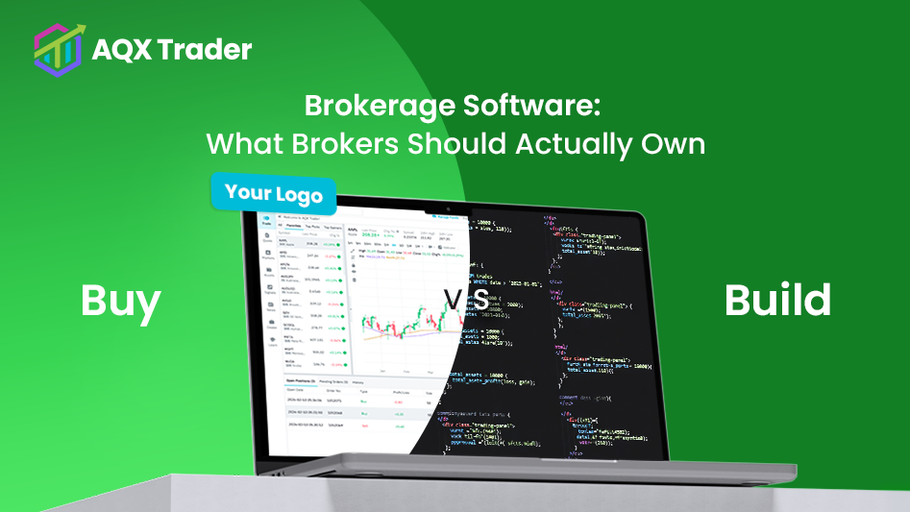
Every broker eventually faces the same decision: build a trading platform from scratch, or buy one and configure it. On the surface, the answer seems obvious. Build it and you own it. Buy it and you're dependent on someone else.
That logic sounds right. It is mostly wrong.
The real question is not build versus buy in the abstract. It is about which parts of the stack are worth building, and which parts will cost you two years and a team of engineers only to land at roughly where a proven platform already sits. Getting that distinction wrong is expensive. Not just in money, but in speed, in trader experience, and in the operational drag that follows every broker who tries to maintain more than they should.
The Default Assumption Behind "Build It"
When brokers lean toward building their own platform, the reasoning usually comes down to control. They want to own the product, set the roadmap, make changes without asking a vendor. That instinct is valid. But "building your own platform" rarely delivers the kind of control brokers actually care about.
What brokers actually care about is the ability to:
- Customise the brand and trader-facing experience without delays
- Adjust symbols, leverage, and account types without a support ticket
- Launch in new markets without starting over
- Iterate on UX based on trader behaviour
None of those things require building a trading platform from scratch. They require choosing a platform that gives brokers genuine configuration depth and operational control post-launch.
Building from scratch usually delivers the opposite: high initial cost, a long pre-launch runway, and a maintenance burden that never goes away. The engineering team that built the platform has to keep maintaining it. Every new asset class, every device update, every regulatory adjustment becomes an internal project.
What "Building" Actually Costs
The hard costs are obvious: development salaries, infrastructure, QA, security audits, and the ongoing cost of keeping the system running. Brokers who have gone this route often cite initial builds running to seven figures before a single trader logs in.
The softer costs are harder to budget for:
Time to market. A custom-built platform can take 18 to 36 months to reach a launchable state. That is time spent not acquiring traders, not testing market fit, not iterating on the product. Competitors using proven white-label infrastructure can be live in a fraction of that time.
Feature parity from the start. A new build starts from zero. A mature white-label platform comes with mobile apps, web trader, charting, one-click trading, and a back-office layer that took years to develop. Rebuilding feature parity is a significant undertaking that most brokerages do not account for.
Ongoing maintenance. Every platform has bugs. Every platform needs updates. When a broker owns the codebase, they own those problems. That is a permanent cost, not a one-time investment. The change tax, integration tax, and incident tax that accumulate after launch are well-documented in practice — and rarely visible in the original build budget.
None of this means custom development is always the wrong call. It means the bar for justifying it should be high, and most brokers do not clear it.
The Three Layers of a Brokerage Tech Stack
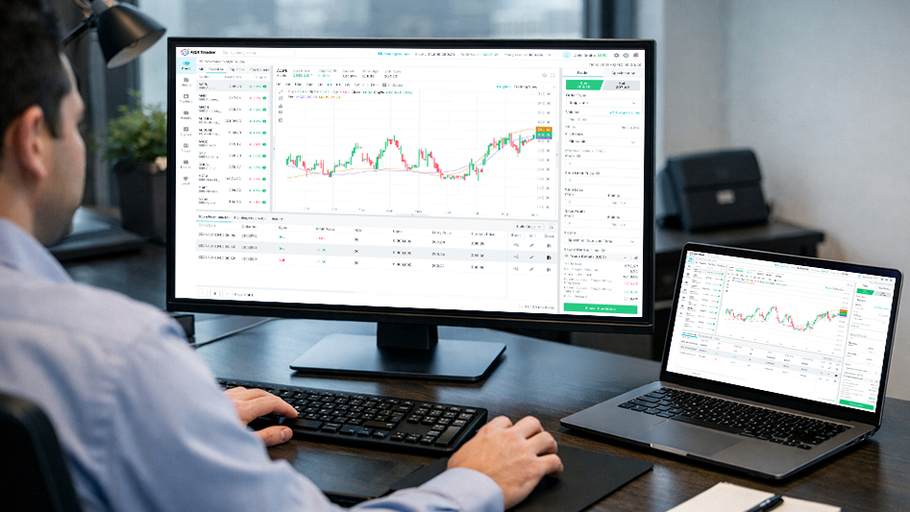 To think clearly about build vs buy, it helps to separate the brokerage tech stack into layers — and be honest about what each layer does.
Layer 1: Execution and Liquidity Infrastructure
This includes the OMS, the EMS, liquidity aggregation, FIX connectivity, and trade routing. It is the engine room. Traders never see it directly, but it determines pricing, execution quality, and how cleanly orders move through the system.
This is almost never a candidate for building from scratch. The engineering complexity is enormous, the regulatory stakes are high, and the financial cost of getting it wrong is real — in execution errors, counterparty disputes, and reputational risk. Most brokers source this from established infrastructure providers and plug it into their stack.
The better strategic question here is connectivity: how flexibly can the front end and back-end connect? A platform that supports multi-OMS architecture and dual FIX/REST protocols gives brokers more routing options without having to rebuild either side.
Layer 2: The Trader-Facing Front End
This is the platform traders log into. The web trader, the mobile app, the desktop experience, the charts, the order interface. This is where trader perception is formed — and where most of the build vs buy debate actually lives.
Building a good trading front end is harder than it looks. Cross-device consistency alone is a serious engineering challenge. Traders who start a trade on desktop expect it to behave the same way on mobile. Session continuity, layout persistence, fast order execution — these are the things traders notice when they go wrong, not when they go right.
Buying here — in the form of a configurable white-label front end — makes sense for most brokers. Not because they should give up on differentiation, but because differentiation happens through configuration, branding, and UX choices, not through the underlying code. Traders do not care who wrote the rendering engine. They care how fast the platform loads and whether the charts are any good.
What brokers should demand from a white-label front end is genuine configuration depth: control over the symbol list, layout defaults, feature toggles, branding, and the live versus demo environment. Desktop execution tools like one-click trading and in-chart trading are also part of this layer — they directly reduce execution friction for traders and support load for brokers. If those controls are there, the broker owns the trader experience without owning the codebase.
Layer 3: Broker Operations and Back-Office Controls
This is the layer that most discussions of build vs buy ignore entirely, and it is where a lot of operational pain lives.
After launch, brokers need to be able to add instruments, adjust leverage presets, push announcements, toggle features, manage client accounts, and separate live and demo environments. If those changes require a developer or a vendor support ticket every time, the broker has lost operational control regardless of whether they built the platform or bought it.
This is where broker-side CMS functionality matters. A platform that gives the broker direct control over their operational configuration is one that scales without creating engineering dependency. A platform that requires vendor involvement for routine changes is not giving the broker control — it is just hiding the dependency.
What Brokers Should Actually Own
Given those three layers, the answer to build vs buy becomes more specific:
Own the brand and trader experience. This means selecting a white-label platform that gives genuine configuration depth — not just logo placement and colour schemes, but layout control, feature selection, symbol management, and the ability to localise for different markets.
Own the operational controls. A platform that requires a vendor every time a broker wants to update a banner or add an instrument is not operationally owned. Brokers should hold out for genuine back-office control: direct access to live and demo separation, leverage settings, account defaults, and the ability to make routine changes without engineering involvement. This matters even more at the point of expansion into new markets — where operational responsiveness becomes a credibility signal, not just an internal convenience.
Own the integration choices. Execution providers, liquidity, analytics, signals, payment processors — these are business decisions, not technical dependencies. A good white-label platform supports open integration so brokers can connect the providers they want without being locked into a prescribed stack.
Do not try to own the infrastructure. OMS, EMS, low-latency routing, multi-protocol connectivity — these are commodity inputs for most brokers. Buy them from providers who have already solved the hard problems and can prove it with uptime, SLAs, and infrastructure credentials.
The Real Risk of Buying the Wrong Platform
Choosing to buy rather than build is the right move for most brokers. Choosing the wrong platform to buy is a different kind of expensive.
The common failure modes:
Limited post-launch configurability. A platform that looks flexible during the sales process but requires vendor involvement for every change after signing. Brokers end up waiting weeks for changes that should take hours.
Weak mobile or cross-device experience. Traders increasingly move across devices within a single session. A platform that is strong on desktop but inconsistent on mobile creates friction that pushes traders toward competitors.
Single OMS lock-in. If the platform only connects to one OMS, the broker has no routing flexibility. Switching execution providers later means switching platforms.
No separation of live and demo. Demo quality is often how brokers acquire traders in the first place. A platform that does not give the broker full control over the demo environment — with proper configuration of instruments, leverage, and account defaults — leaves conversion on the table.
No ecosystem. A standalone platform with no integrations is an island. Brokers need signals and analytics tools to keep traders engaged, social or strategy-following features for acquisition, and payment providers for frictionless deposits and withdrawals. These should integrate, not require custom builds.
What to Look for in a White-Label Trading Platform
 If the decision is to buy — and for most brokers, it should be — the evaluation should focus on five things:
1. Configuration depth, not just customisation. Logo swaps and colour schemes are not configuration. Real configuration means broker control over instruments, leverage, feature toggles, layout defaults, and environment settings — all without a support ticket.
2. Cross-device consistency. The platform should behave the same across desktop, web, and mobile. That means session continuity, layout persistence, and the same feature set regardless of device. Ask to test all three before signing.
3. Multi-OMS connectivity. At minimum, the platform should support more than one OMS and offer FIX and REST connectivity. If the execution relationship changes, the broker should not have to replace the front end.
4. Demo environment control. Brokers should be able to configure the demo experience independently from live — with different instrument lists, leverage settings, and account defaults if needed. A strong demo is a direct acquisition tool.
5. Integration ecosystem. TradingView for charting, third-party signals providers, social or copy trading networks, payment processors — these should be available through existing integrations, not custom development projects.
Where AQX Trader Fits in This Decision
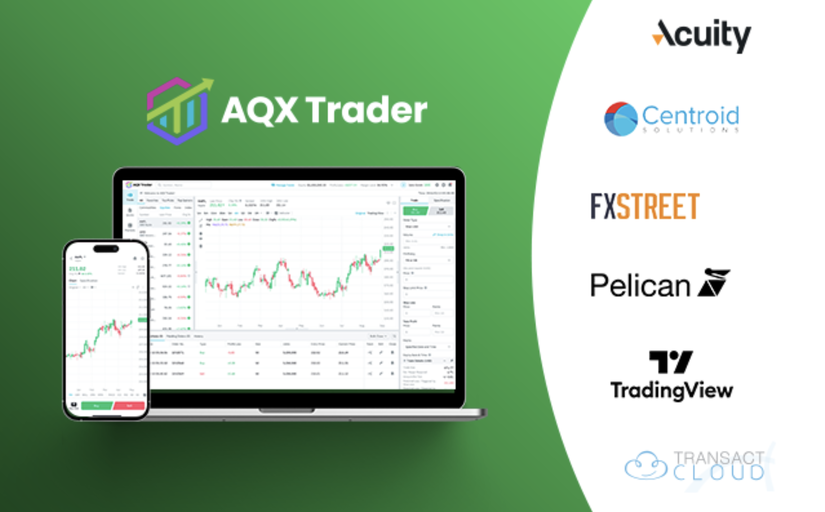 AQX Trader is a white-label multi-asset trading platform built specifically for brokers and financial institutions. The product covers the trader-facing front end — across desktop, web, mobile app, and mobile web — with a broker-side control layer that gives direct access to configuration without engineering dependency.
The platform connects to multiple OMS providers via FIX and REST, integrates with TradingView, Acuity Signals, FXStreet, Centroid Solutions, TransactCloud, and Pelican Network, and gives brokers a CMS-style back office for operational changes. Live and demo environments are managed independently.
For brokers evaluating build vs buy, AQX Trader is designed to address the configuration gap — the point where white-label platforms typically give up control — without requiring a custom codebase.
The platform is available for evaluation through a demo environment. Brokers can test the front-end experience across devices before committing.
The Practical Summary
Build vs buy brokerage software is the wrong frame if it leads to an all-or-nothing decision.
Most brokers should buy the infrastructure and the front end, and own the brand, the configuration, the integrations, and the operational controls. The goal is not to build less — it is to build in the right places, and select vendors who make broker control the default rather than an upgrade.
The competitive advantage for most brokers is not a proprietary codebase. It is speed to market, operational flexibility, and a trader experience that consistently works. A white-label platform with genuine configuration depth delivers all three faster than a custom build, at a fraction of the cost, and without the ongoing maintenance burden that comes with owning every line of code.
For brokers still considering the custom build route: it is worth asking how many of the capabilities on that roadmap already exist, proven and maintained, in a platform that can be configured and launched in months rather than years.
Try out the award-winning white-label multi-asset trading platform here.
AQX Trader is a white-label multi-asset trading platform for brokers and financial institutions. Built for brokers, designed for traders.
Latest News
