
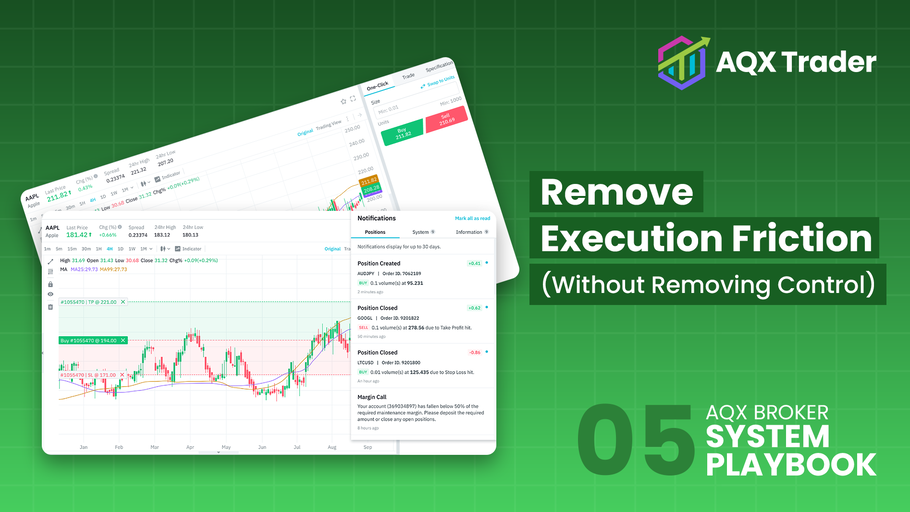
Execution friction rarely stays on the chart. It becomes support load, dealer escalation, and time spent pulling logs after a volatile session. Playbook 04 focused on a retail-friendly interface that reduces hesitation at the surface. This next step removes friction at the moment of execution.
Active traders don’t describe this as “workflow.” They describe it as missed entries, late exits, and avoidable mistakes. Even when execution is technically correct, the experience can still feel slow if the process forces extra steps at the worst possible time. Reliability and clarity are operational stakes, not design preferences.
One-click Trading for Faster Entries & Exits
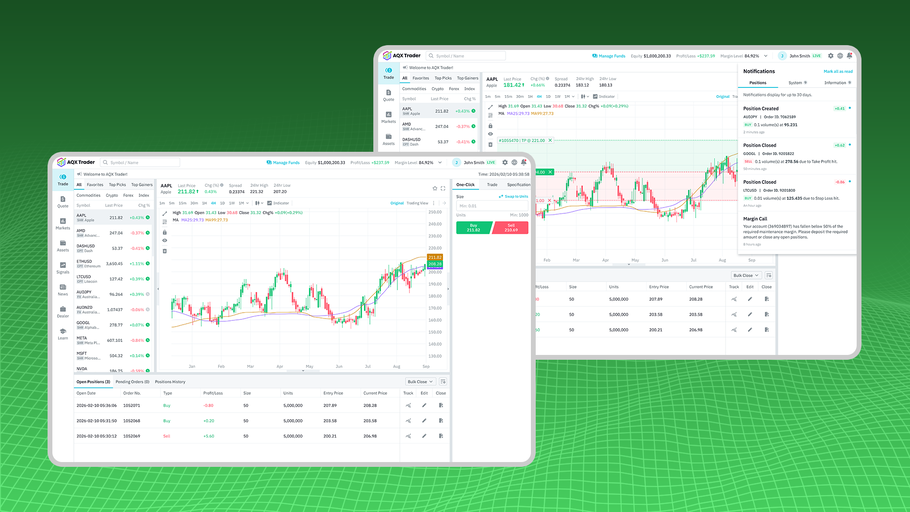 One-Click Trading targets urgency directly on AQX Trader desktop. With a single interaction, traders can open or close positions from the order book or price panel, bypassing confirmation screens and reducing time-to-market. This matters most during news releases, high-volatility moves, and breakout scenarios where speed becomes part of the strategy. The feature is positioned for high-frequency, short-term, and scalping styles, where hesitation is a cost. It also reduces the “wrong button, wrong moment” problem because fewer screens means fewer chances to misfire.
Broker Governance for One-Click Trading
Speed without governance creates noise. A familiar ops pattern is a newer account clicking rapidly into a spike, ending up oversized, then disputing the outcome when price snaps back. AQX Trader addresses that by keeping safety and control in the broker’s hands: One-Click Trading can be enabled or disabled per user group, and activation requires terms-of-use agreement. This setup supports tiered access based on maturity, behaviour, or account classification. It also creates a clear internal stance when disputes arise: the feature was intentional, gated, and acknowledged.
In-Chart Trading for Precision Execution
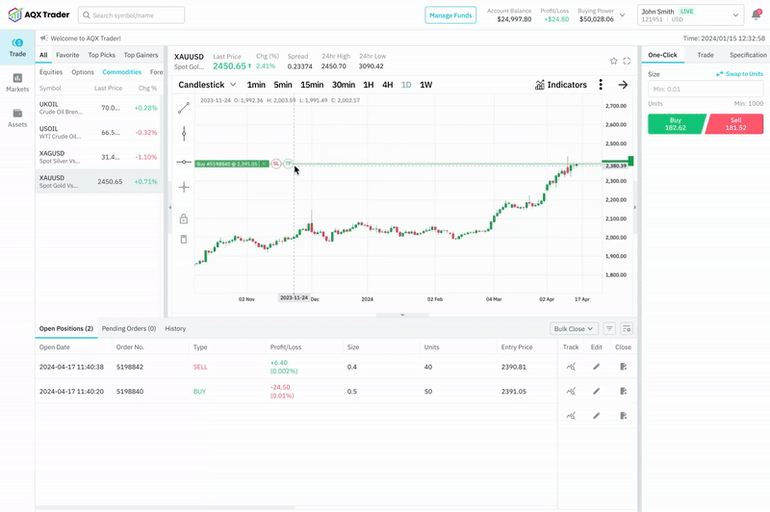 In-Chart Trading focuses less on raw speed and more on reducing context switching. Trades can be placed, modified, or cancelled directly within the chart interface instead of bouncing between charts and order tickets. Take-profit and stop-loss levels respond to drag-and-drop movements, snapping intuitively to support, resistance, or trendlines. That reduces price re-entry errors and misclicks, which are quiet sources of post-trade complaints. It also keeps risk visible, because the stop and target live on the same canvas that produced the trade decision.
Technical Trading Workflows: Advanced Drawing Tools & Custom Indicators
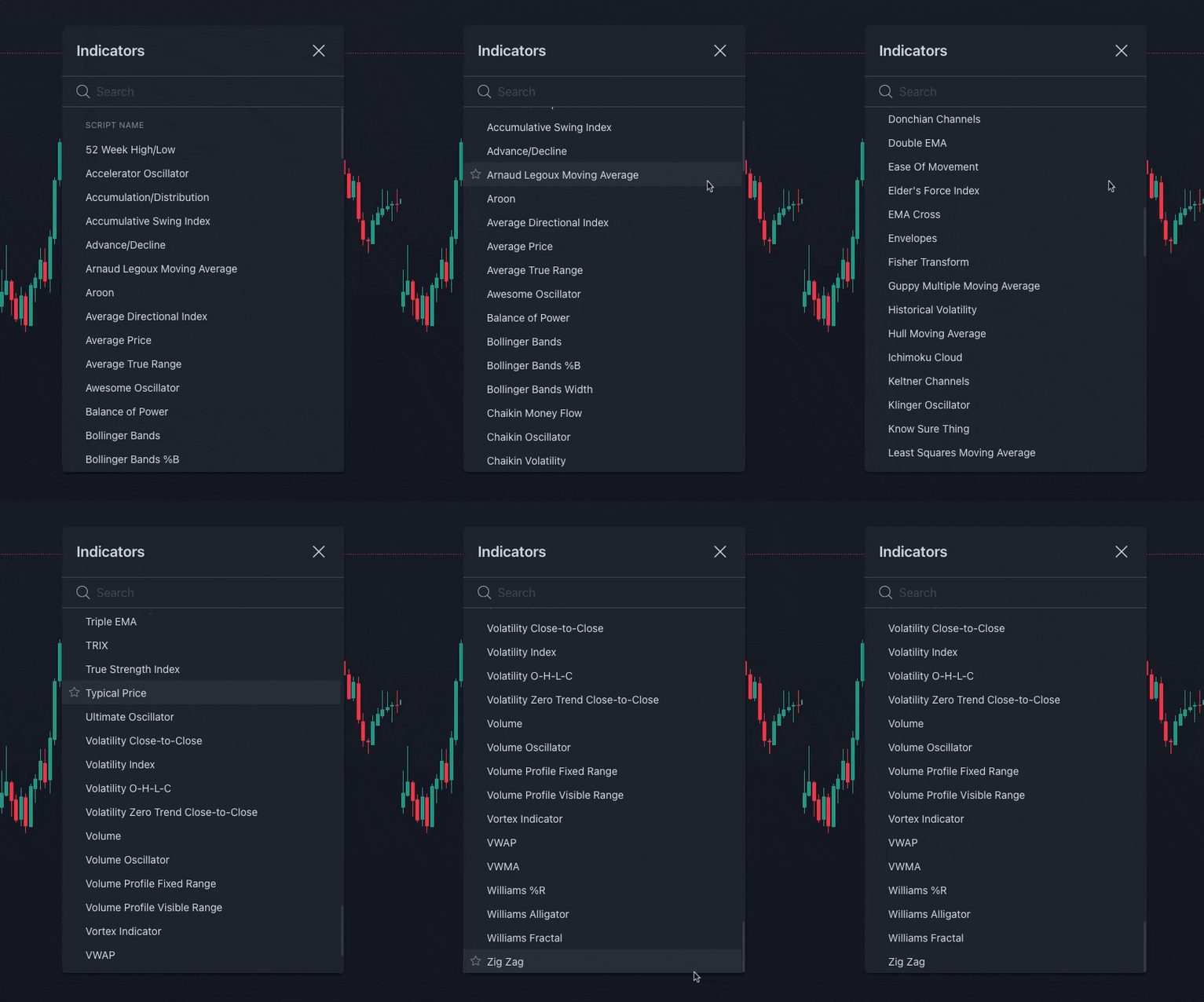 Technical traders often need to act at the exact point where structure changes. AQX Trader highlights that in-chart actions can react in real time to moving averages, Fibonacci zones, and custom drawing tools and indicators, converting analysis into immediate execution.
That alignment matters for broker outcomes because fewer intent-to-order mismatches typically means fewer “platform error” claims. It also supports cleaner trade management, since adjustments happen visually rather than through repeated manual inputs. Over a high-volume cohort, these small reductions in error rates add up.
Technical traders often need to act at the exact point where structure changes. AQX Trader highlights that in-chart actions can react in real time to moving averages, Fibonacci zones, and custom drawing tools and indicators, converting analysis into immediate execution.
That alignment matters for broker outcomes because fewer intent-to-order mismatches typically means fewer “platform error” claims. It also supports cleaner trade management, since adjustments happen visually rather than through repeated manual inputs. Over a high-volume cohort, these small reductions in error rates add up.
Broker Rollout Runbook: Deploy Execution Speed as a Controlled Programme
Treat rollout like an ops programme, not a blanket toggle. Start with a defined active cohort, enable one-click via user-group controls, and enforce terms of acknowledgement before activation. Position in-chart execution as the broader precision upgrade, since it improves clarity without encouraging rapid-fire clicking. Track ticket categories tied to execution mistakes, not just trade volume, because volume can rise for the wrong reasons. Widen access only when behaviour stays clean and error patterns stay down.
Outcome: Clearer Intent, Clearer Execution, Steadier Operations
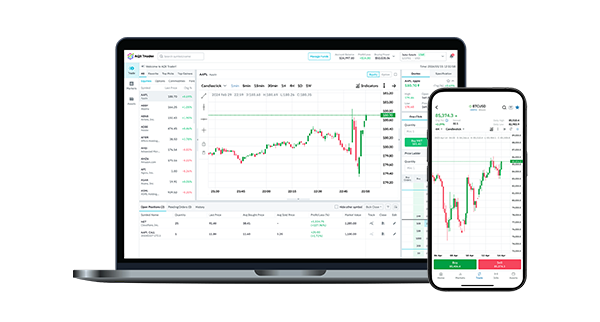 A trading platform should not be the source of hesitation or avoidable errors. When execution tools remove dead steps and keep risk visible, active traders stay in flow and broker teams spend less time mediating preventable disputes. That’s the operational win: clearer intent, cleaner execution, calmer post-trade handling.
The line "Built for Brokers, Designed for Traders" fits best when it reflects these outcomes in live sessions. Book a demo or Contact us now to review the desktop execution flow end-to-end.
A trading platform should not be the source of hesitation or avoidable errors. When execution tools remove dead steps and keep risk visible, active traders stay in flow and broker teams spend less time mediating preventable disputes. That’s the operational win: clearer intent, cleaner execution, calmer post-trade handling.
The line "Built for Brokers, Designed for Traders" fits best when it reflects these outcomes in live sessions. Book a demo or Contact us now to review the desktop execution flow end-to-end.